
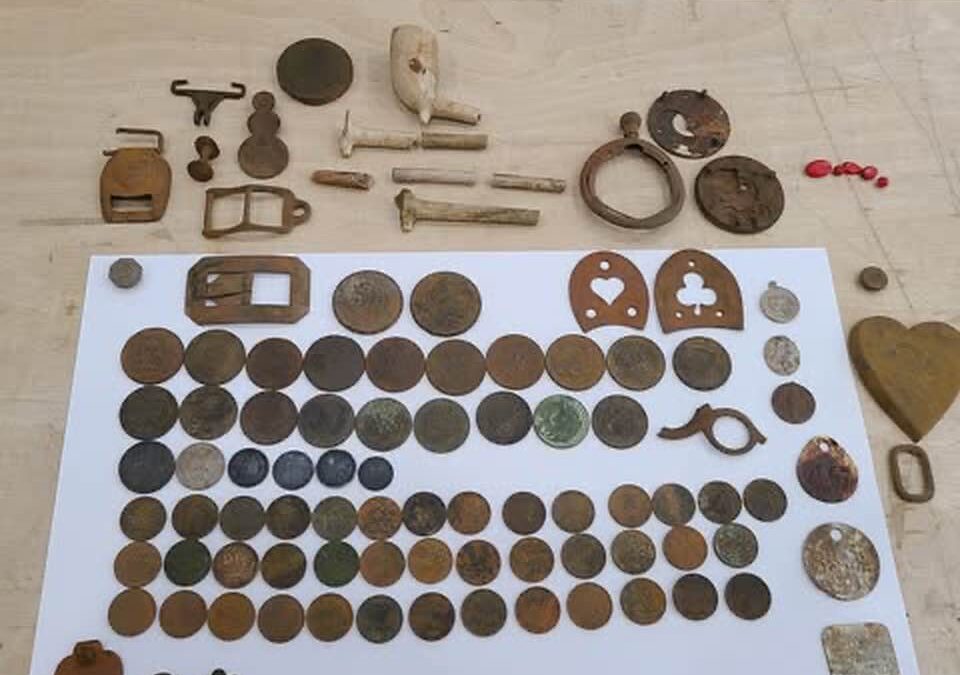
Spread across the white sheet in the photo is a mixed lot of history: roughly 50–60 round coins or token-like discs, along with other metal, above them are buckles, rings, hardware that show signs of having spent some long years in wet mossy ground. Many of the round pieces show the familiar brown and green patina you see on old copper or bronze items. That kind of oxidation doesn’t happen overnight. It’s the slow signature of time.
On a river like the Dumoine, used for generations as a travel route, small objects like coins and tokens are exactly the kind of thing that turn up near old landings, portages, camps, crossings, and cabins. They’re easy to lose, hard to notice in the moment, and surprisingly durable once they settle into the soil.
What these coins might be telling us
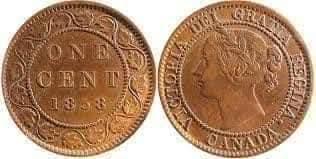
A large portion of the round pieces in this photo appear to be “large cent” sized. These are the big, older one-cent coins that are much larger than the pennies most of us grew up with. If some of these measure close to 1 inch / 25.4 mm across, they sit right in the range of Canada’s early cent coinage and the long era of large cents that followed. Large cents stayed big until 1920, so the coins measuring around that 25 mm mark have a decent chance of being from the 1858–1920-era cents.
A smaller set of the coins are darker and noticeably smaller. Those could be smaller denominations (like early 5¢ silver pieces, which were tiny), but are too corroded and low-detail to say reliably. The size mix in the coins found on the Dumoine routes fit what we know about how money circulated in Canada in the mid-1800s. When a coin like this shows up, you’re witnessing an authentic part of colonial Canadian history.
Why this matters for Friends of Dumoine
Friends of Dumoine exists to protect the watershed and to strengthen knowledge of its natural environment and human history. Finds like these sit right at that intersection. They don’t just say “someone was here.” They hint at how people moved through the region and what they carried, during a time when everyday money was a blend of official coins and locally issued tokens.
Just as importantly, the condition of these pieces is a reminder that the Dumoine landscape is both generous and fragile. Wet soils preserve metal. Shorelines shift. Campsites evolve. What we do today: where we walk, where we camp, what we leave behind, becomes tomorrow’s story.
A note on respectful discovery
If you come across coins or historic objects while travelling, the best approach is simple: don’t dig, don’t disturb sensitive areas, and don’t scrub or polish items (cleaning can erase details and damage surfaces). If an item is significant, or you’re unsure, take a photo, note the general location, and reach out so it can be documented properly.
If you see anything that may be harmful to the environment or want to report conditions, you can email: dumoinefriends@gmail.com.
Canada’s first cents – why “large cents” mattered?
On December 12, 1858, the first Canadian cent was minted with a diameter of 1 inch (25.4 mm) and a weight of 1/100 of a pound (4.54 g). These early cents were introduced to bring order to a monetary system that, until then, was a patchwork of British coinage, bank and merchant tokens (often called sous by francophones), U.S. currency, and Spanish milled dollars.
Interestingly, the coin’s specifications were chosen in part so it could double as a kind of measuring tool. But there was a practical problem: the cent was very light compared with the heavier bank and merchant tokens people were used to handling. That light weight made the new coins harder to accept, and some were even circulated at roughly a 20% discount. When Canada became a Dominion in 1867, some of those discounted cents were effectively inherited by the new government.
Production didn’t need to ramp up again until 1876, when the cent’s weight was increased to about 5.67 grams. From 1858 to 1920, Canadian large cents remained significantly bigger than modern one-cent coins, and even slightly larger than today’s 25¢ piece. After Confederation, these large cents were struck on the planchet of the British halfpenny and were treated as roughly equivalent in value. Pennies were issued sporadically through the later 1800s, and different colonies and provinces issued their own “pennies” until they joined Confederation or later entered Canada.
If you’re looking at a collection of old, copper-based discs that cluster around that one-inch size, it’s not hard to see why “large cents” (and cent-sized tokens) show up so often in old travel corridors.
Early five-cent pieces — from small silver to the “nickel”
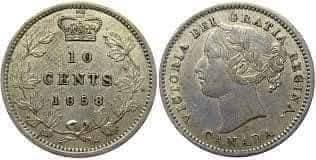
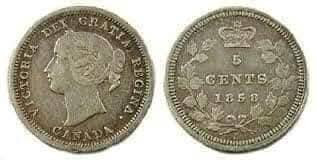
Canada’s first five-cent coins were also struck in 1858, as part of the Province of Canada’s first decimal coinage (1¢, 5¢, 10¢, 20¢). The five-cent coin was based on the American half dime in size and general composition, and Canada’s five-cent coins stayed small and silver far longer than the American equivalent, remaining silver until 1922.
Until 1908, Canadian coins were struck in England at the Royal Mint (typically no mint mark) and the Birmingham Mint (often with an “H” mint mark). That changed when the Ottawa branch of the Royal Mint opened in 1908. (With rare exceptions, Canadian coins minted after that have been produced in Canada.)
As silver prices rose, Canadian coinage was debased from sterling (925 fine) to 800 fine in 1920. Then, in 1922, silver was removed entirely from the five-cent coin and replaced with a coin made of pure nickel, Canada being one of the world’s major producers of that metal. That’s where the five-cent coin’s everyday name comes from: the nickel.
If any of the smaller, darker coins in a collection are old five-cent pieces, they may represent that earlier era when five cents was a small silver coin, though confirming that requires clear photos of both sides, or at least readable details.
More History on Candian Coins
To read more about the history of trade and coinage in Canada, check out these resources.
– History of Canadian currencies – Wikipedia
– A History of the CANADIAN DOLLAR
– Money in Canada | The Canadian Encyclopedia
Join Us !
Friends of Dumoine is volunteer-led, and support goes into practical work, maintaining trails and routes, improving safety and signage, protecting the watershed, and sharing the knowledge that helps people travel responsibly.
If you’d like to be part of that effort:
-
Become a member: https://friendsofdumoine.ca/membership/
-
Volunteer: https://friendsofdumoine.ca/volunteer-committees/#bottom
-
Read the etiquette guide before you go: https://friendsofdumoine.ca/etiquette/