Hiking Through History

The Dumoine River is one of the last accessible undammed whitewater rivers in Canada, and it is renowned for its characteristics. But as of 2023, the Dumoine River can be explored on foot along a 26 kilometre hiking trail that is appealing to backpackers and day hikers alike. Thanks to the sterling efforts of Friends of Dumoine volunteers over a period of five years, an 1840s historic logging trail (tote road) has been rehabilitated and reopened. This new hiking trail follows the historic road for roughly half of the journey from the Ottawa River to Grande Chute, and it links to existing (ancient) river portages to follow closely to the Dumoine River. The rapids and chutes of the Dumoine are spectacular, and along the trail there are 26 new campsites and 4 side trails that lead to scenic lookouts. The Dumoine Valley has not been logged in over 100 years, so this trail system is through mature pine and hardwood forests.
From 2019–2024, Friends of Dumoine volunteers worked to clear the historic tote road and the associated historic sites, build bridges over creeks, build campsites, establish emergency shelters, and put up trail signage and information kiosks. In 2023 and 2024, more than 200 backpackers visited the Dumoine Tote Road trail. Although it is more popular in the warmer weather, winter is a great time to come to ski, snowshoe, and camp in this backcountry paradise.
The absence of logging has left the traces of history from 1800s logging undisturbed, which is very rare. Along the trail there are 6 historic sites and they are actively being mapped and researched, with information kiosks being established for hikers to stop and read. The historic sites include stopping places (frontier hotels), lumber camps, a riverdrive camp, the world’s longest log chute (timber slide) and a sawmill site from when the log slide was constructed. There are campsites at many of these historic sites, and while camping there, some hikers feel the presence of what was a very busy and noisy place for over a century. Hiking through history along the Dumoine Trail is an incredible experience.
Jump Ahead :
Hiking Sentier Dumoine
This trail system requires some effort to access, but the rewards far outweigh the effort. There are two official “trailheads”: one on the Ottawa River (Holden Lake) across from Driftwood Provincial Park, and the other at km26 on Chemin Dumoine, a rough forest access road. Either way, registration with ZEC Dumoine is required, where small fees are collected, but these fees help us maintain the trail system.
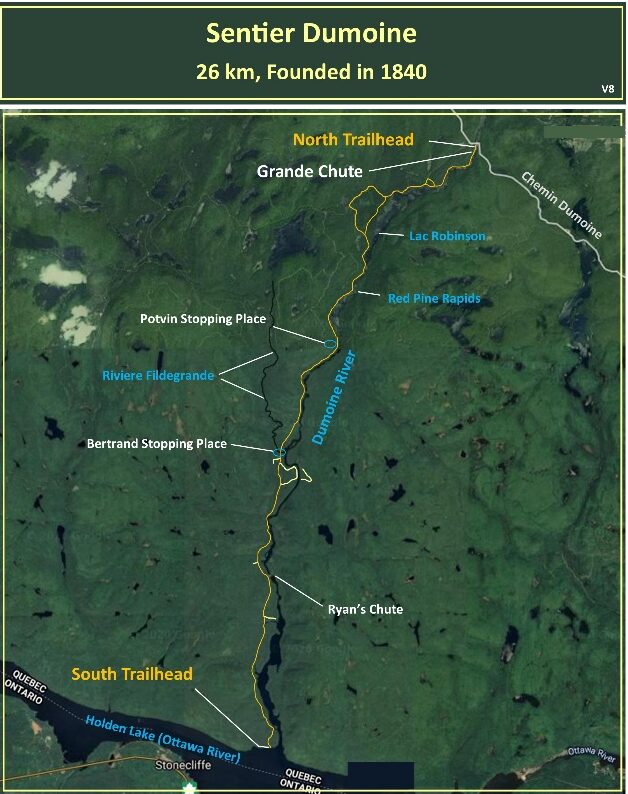
Hiking from the South Trailhead at the Ottawa River
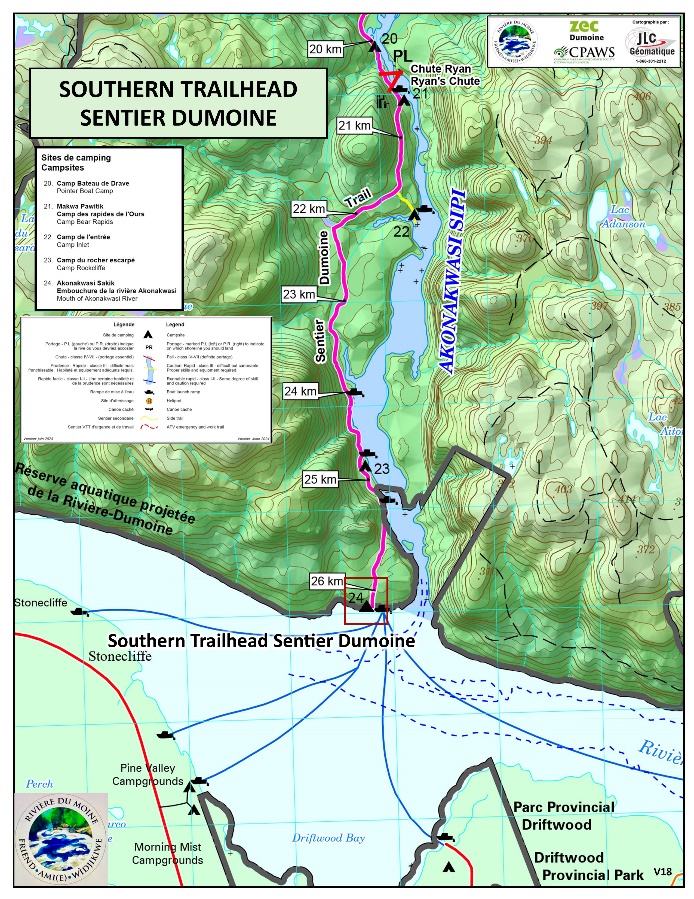
The southern 5 km of the Dumoine Valley was flooded in 1950 when the hydroelectric dam at Rolphton was built. Hikers can canoe or kayak across the Ottawa River (the Holden Lake reservoir), launching from the Stonecliffe Public Boat Launch or from the boat launch at Driftwood Provincial Park (for which a Park pass is also needed). The hiking trail can be accessed at the south trailhead and at several other locations along the flooded region. The landing location can be selected based on what your ambitions are for hiking.
Accessing the south trailhead and other boat access points is also possible (and recommended) by purchasing motorboat shuttle service from two outfitter services in the area: Morning Mist Resort near Stonecliffe ON (613-586-1900 or 888-356-1113) and Les Guides de la Vallée Dumoine (outfitter) near Rapides des Joachims PQ (613-586-2300).
HOLDEN LAKE IS A LARGE BODY OF WATER AND WIND AND WAVES CAN MAKE THIS CROSSING DANGEROUS, SO CAREFUL PLANNING IS REQUIRED.
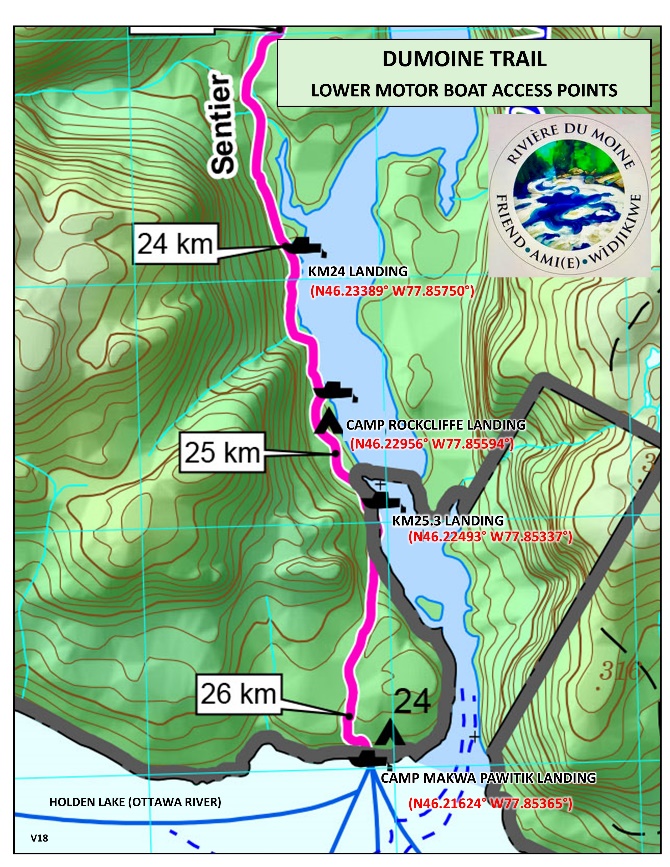
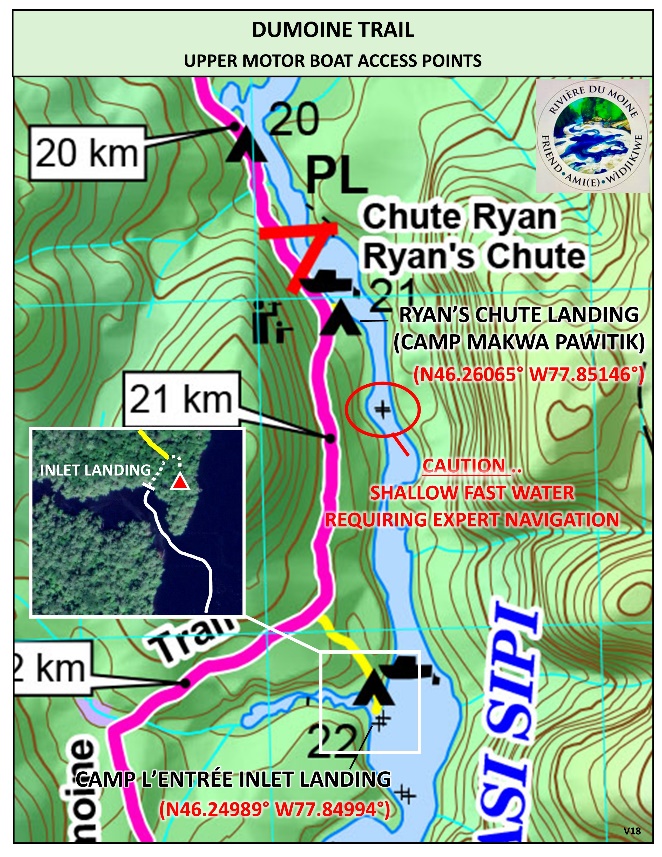
Day Hiking from the South Trailhead and Other Boat Access Points
Day hikers can hike to Ryan’s Chute or historic Bertrand Stopping Place at the Fildegrande River, depending on the selected boat landing location and the time and ambitions and capabilities of the hikers.
| Landing/Start Location | Destination | Distance (one way) |
Duration* (hours both ways)
|
| South Trailhead (km26.4) | Ryan’s Chute (km20.4) | 6.0 km | 4 to 6 hours |
| South Trailhead (km26.4) | Bertrand (km16) | 10.4 km | 8 to 10 hours |
| Camp Entrée (~km22) | Ryan’s Chute (km20.4) | 1.6 km | 1 to 2 hours |
| Camp Entrée (~km22) | Southview Lookout (km19.3) | 2.7 km | 2 to 3 hours |
| Camp Entrée (~km22) | Bertrand (km16) | 6.0 km | 4 to 6 hours |
| Ryan’s Chute** (km20.4) | Southview Lookout (km19.3) | 1.1 km | 1 to 1.5 hours |
| Ryan’s Chute** (km20.4) | Bertrand (km16) | 4.4 km | 4 to 6 hours |
| Ryan’s Chute** (km20.4) | Bertrand via Kickapika Loop | ~5.5 km | 5 to 7 hours |
*Durations assume hiking pace of 2 to 3 km/h with some margin
** Canoe/kayak access is not possible in May and challenging in June because of river flow between Camp Entrée and Ryan’s.
Aside from the magnificent forests, the southern sector of Sentier Dumoine offers the scenery and sounds of Ryan’s Chute, the historic logging camp at Camp Entrée, and a spectacular south-facing view of the Dumoine Valley at Southview Lookout.
Multi-Day Hiking from the South Trailhead
A multi-day backpacker hike from the southern end of the trail can include all of the other sights and amenities of Sentier Dumoine north of the Fildegrande River. Several options are available for backpackers.
The “up and back” option it to hike north to Grande Chute, then back south to the starting point. To experience the entirely of Sentier Dumoine (i.e., to include time to explore the scenic lookouts at Southview Lookout, Bellevue Sud-Est, Bellevue Kickapika, Bald Eagle Cliff, and the Grande Chute), 4 or 5 days is recommended.
While this adventure can be facilitated by canoe/kayak access, the river crossing adds hours of time and uncertainty regarding safe river crossing conditions (wind and waves), and therefore if trip planning cannot include contingencies for the crossing, it is recommended that a boat shuttle service be included. Shuttle services are available from Morning Mist Resort near Stonecliffe ON (613-586-1900 or 888-356-1113) and Les Guides de la Vallée Dumoine (outfitter) near Rapides des Joachims PQ (613-586-2300).
The ”up and shuttle” option is to arrange for boat shuttle to the southern trailhead and a vehicle shuttle from Grande Chute, allowing more time to enjoy the scenic lookout trails and historical sites. Three or four days is recommended for this variation. Les Guides de la Vallée Dumoine (outfitter) near Rapides des Joachims PQ (613-586-2300) can arrange this shuttle service.
The ultimate Dumoine experience is to hike north to Grande Chute, then canoe back down the river (“hike and paddle”), for which 5 or 6 days are recommended. Les Guides de la Vallée Dumoine can arrange this hybrid adventure (shuttle service and canoe rental).
.
Hiking from the North Trailhead at Grande Chute
If you have a high clearance vehicle, you can easily access the north trailhead at Grande Chute by simply driving 26 km along Chemin Dumoine, taking between 40 minutes and one hour. The forest access road is often very rough, and caution is required to manage pot holes, washboard and stoney sections. Logging trucks may also be an important aspect to be aware of, and advice about this can be requested at the ZEC Rapides des Joachims office.
If your vehicle isn’t right for this adventure, or you’re simply uncomfortable with navigating a rough forest access road, you can be shuttled to and from Grande Chute by contacting Les Guides de la Vallée Dumoine (outfitter) near Rapides des Joachims PQ (613-586-2300).
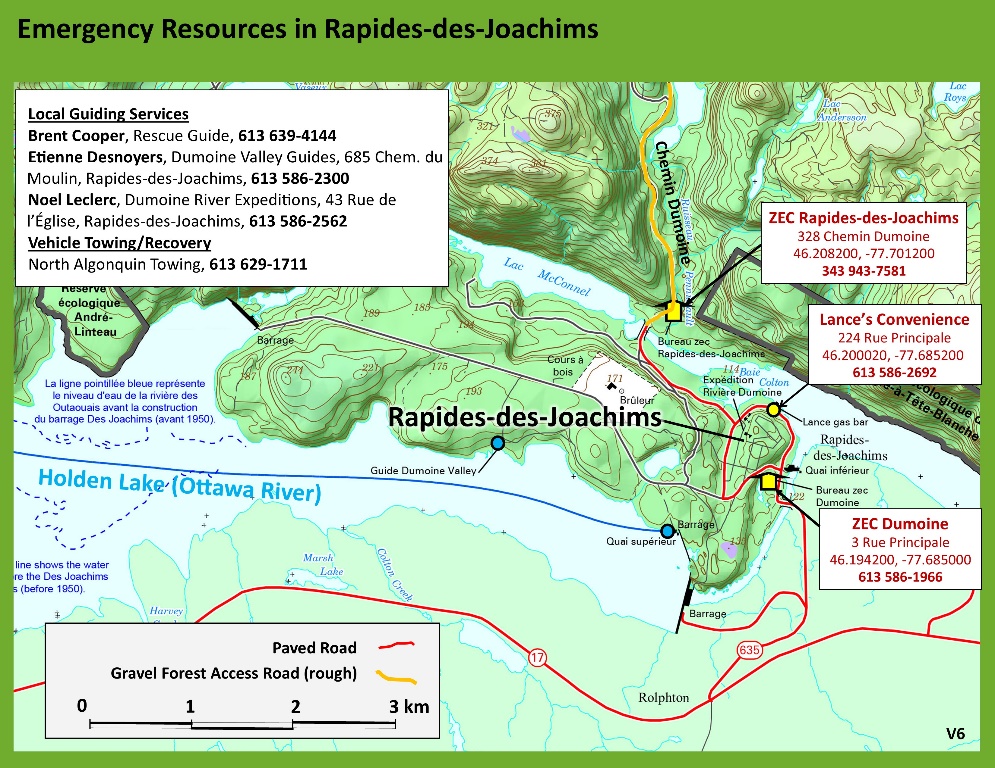
Vehicle access requires registration and fee payments at both the ZEC Dumoine and the ZEC Rapides des Joachims office, but the fees support trail maintenance.
The rewards from this slow bumpy drive are outstanding. Grande Chute is a 1 km long succession of waterfalls and chutes with the first km of the hiking trail, following along side the river on an ancient portage. The Grande Chute is also famous for once having the world’s longest log chute (timber slide), 3800 feet long. A sawmill was established to cut the beams and thick planks to build the slide. There was a camp established at the top of Grande Chute where the men who operated the log slide stayed. These historic features (now just ruins) are highlighted on information kiosks established.
Hiking from the north trailhead is enjoyed by both backpackers and day hikers alike.
North Trailhead Day Hiking Recommendations
Hiking the “Canyon Loop” is an absolute requirement for day hikers. The 1.8 km hike follows Sentier Dumoine from km0 to km1, with many scenic lookouts at the many falls and chutes along this dramatic section of river. Near km1 the hiking trail meets an alternative (shorter) portage trail, where you turn right to return to Grande Chute along the portage trail then (turning right again) along the gravel forest access road that leads to Grande Chute. Near km 0.7 there is a “beach” for swimming (cautiously) in the summer and there are several campsites (Camp Belle Vue at km0.3 and Camp Ankose at km 0.7) where you can enjoy a picnic lunch. Allow 1 to 2 hours for this incredible experience.
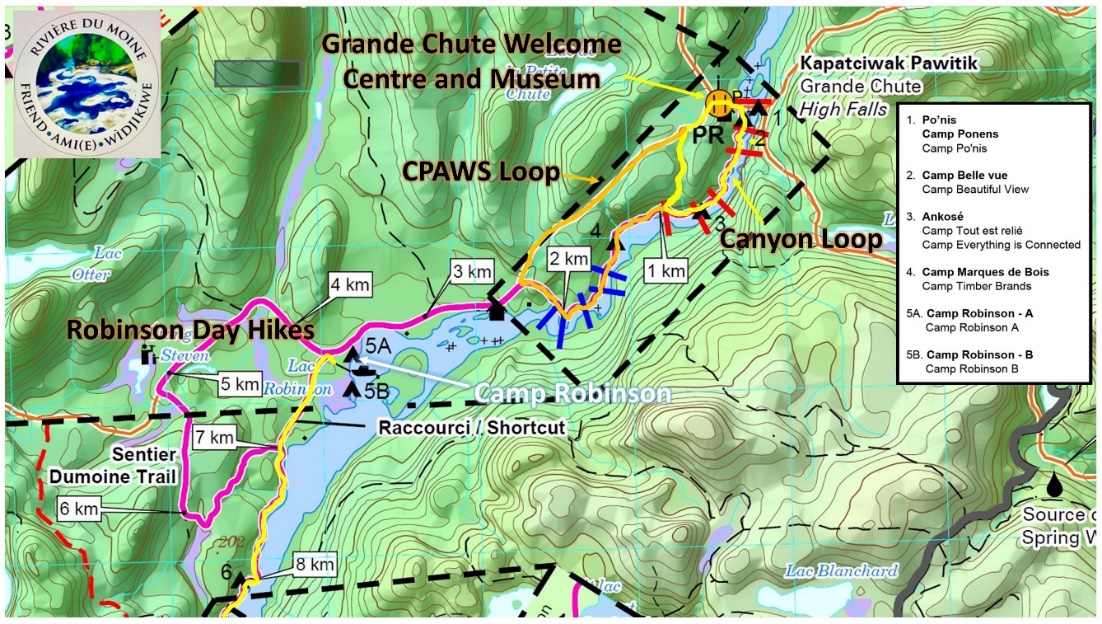
With more time available, it is recommended that day hikers continue past km1 along the next segment of Sentier Dumoine, which is a wilderness trail established by volunteers from the Ottawa Valley chapter of the Canadian Parks and Wilderness Society (CPAWS). Along this segment there is informative signage describing the natural history of the Dumoine Valley, flora, fauna, animals and the weather disturbances that shaped the forests. At km2.4, the trail emerges onto a gravel forest access road, where you turn right and hike along the road back to Grande Chute. Allow 2 to 3 hours for this hike.
Other sights at Grande Chute to include in a day trip are to visit the Grande Chute Welcome Centre (free Wi-Fi and friendly hosts with advice about the trail), the Grande Chute Museum next to the Welcome Centre, and explore the 200m trail that leads you through a historic riverdrive camp where the men who operated the 3800 foot long log slide resided. There is also a spring water tap there.
To explore more of Sentier Dumoine as a day trip, hikers can drive to the Robinson Lake Campground (km3.6) to extend their range, but this road is very stoney in several places. From the Robinson Lake Campground, day hikers can take the Shortcut Trail (raccourci) to quickly get to km7.0, then hike along the shore of Robinson Lake to the top of Red Pine Rapids (km8.7).
The first recommended option for a day trip destination is to continue along the ancient Red Pine Portage to visit the ancient Red Pine tree at Camp Grande Pin, km9.8, enjoying views and sounds of the Red Pine Rapids.
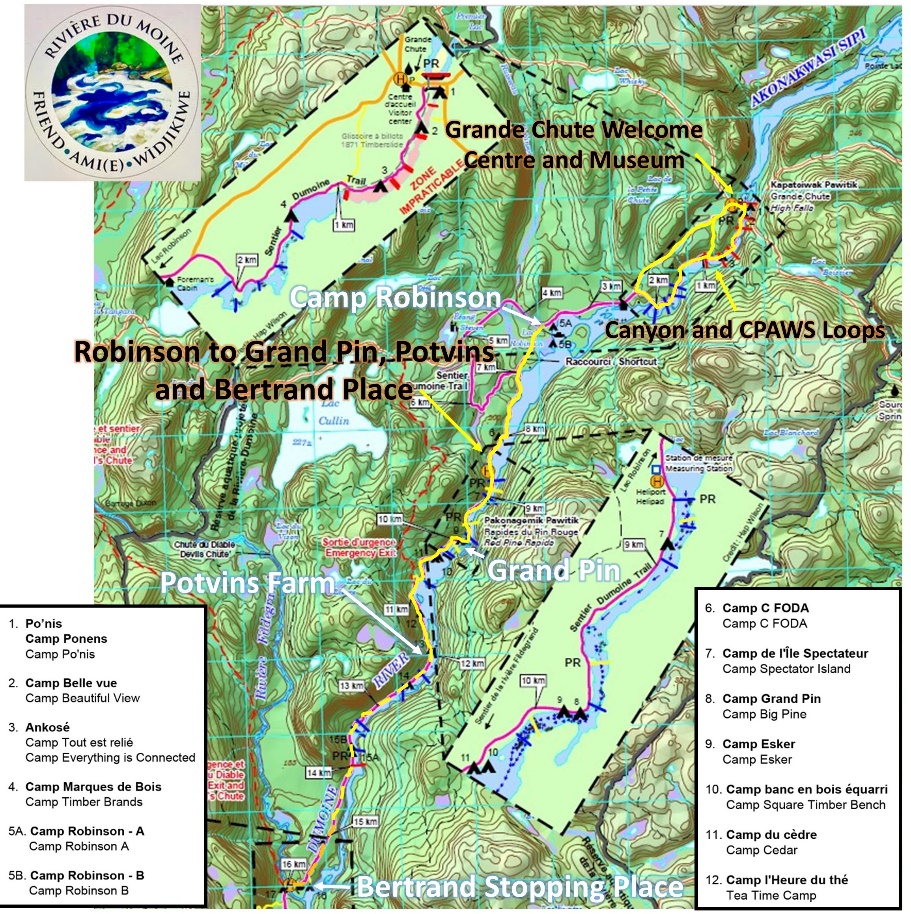
*Durations assume hiking pace of 2 to 3 km/h with some margin.
| Starting Location | Destination | Distance (one way) |
Duration* (hours both ways)
|
| North Trailhead (km0) | Canyon Loop (km1.0) | 1.0 km (1.8 km loop) | 1 to 2 hours |
| North Trailhead (km0) | CPAWS Wilderness Trail segment (km2.4) | 2.4 km (4 km loop) | 2 to 3 hours |
| North Trailhead (km0) | Welcome Centre and Museum | 0 km | 1 hour |
| North Trailhead (km0) | Riverdrive Camp Trail | 200 m loop | 30 minutes |
| Camp Robinson (km3.6) | Camp Grande Pin (km9.8) | 2.7 km | 2 to 3 hours |
| Camp Robinson (km3.6) | Potvin Farm (km11.9) | 5.7 km | 4 to 6 hours |
| Camp Robinson (km3.6) | Bertrand (km16) | 9.7 km | 8 to 10 hours |
North Trailhead Multi-Day Hiking Options
Backpackers camping along the trail can enjoy Sentier Dumoine in several different schemes.
To hike the full length of the trail, putting your feet in the Ottawa River then returning to Grande Chute (“down and back”), the hike can be completed in as little as 3 days for the most energetic hikers, but this would not allow time to explore all of the historic sites and the lookout trails. It is recommended that 4 or 5 days be allocated for the full “down and back” hike.
Another option for hikers is to hike down to the Ottawa River, then be picked up at the South Trailhead by a boat shuttle. This “down and shuttle” hike can be arranged with Les Guides de la Vallée Dumoine (outfitter) near Rapides des Joachims PQ (613-586-2300).
Visit the Friends of Dumoine website (www.friendsofdumoine.ca), where additional information about Friends of Dumoine organization is available, as well as an interactive trail map. At this website, you can register to join FOD and to volunteer to join in with the various activities associated with the trail and the organization. Your support is greatly appreciated.
Friends of Dumoine also maintains a presence on Facebook (FOD Friends of Rivière du Moine) where there are regular posts regarding activities and developments.
FOD has created a paper map of the trail system available for purchase, and the map can be downloaded free from Avenza (www. store.avenza.com). Also available for purchase are T-shirts and decals and other promotional items from time to time.
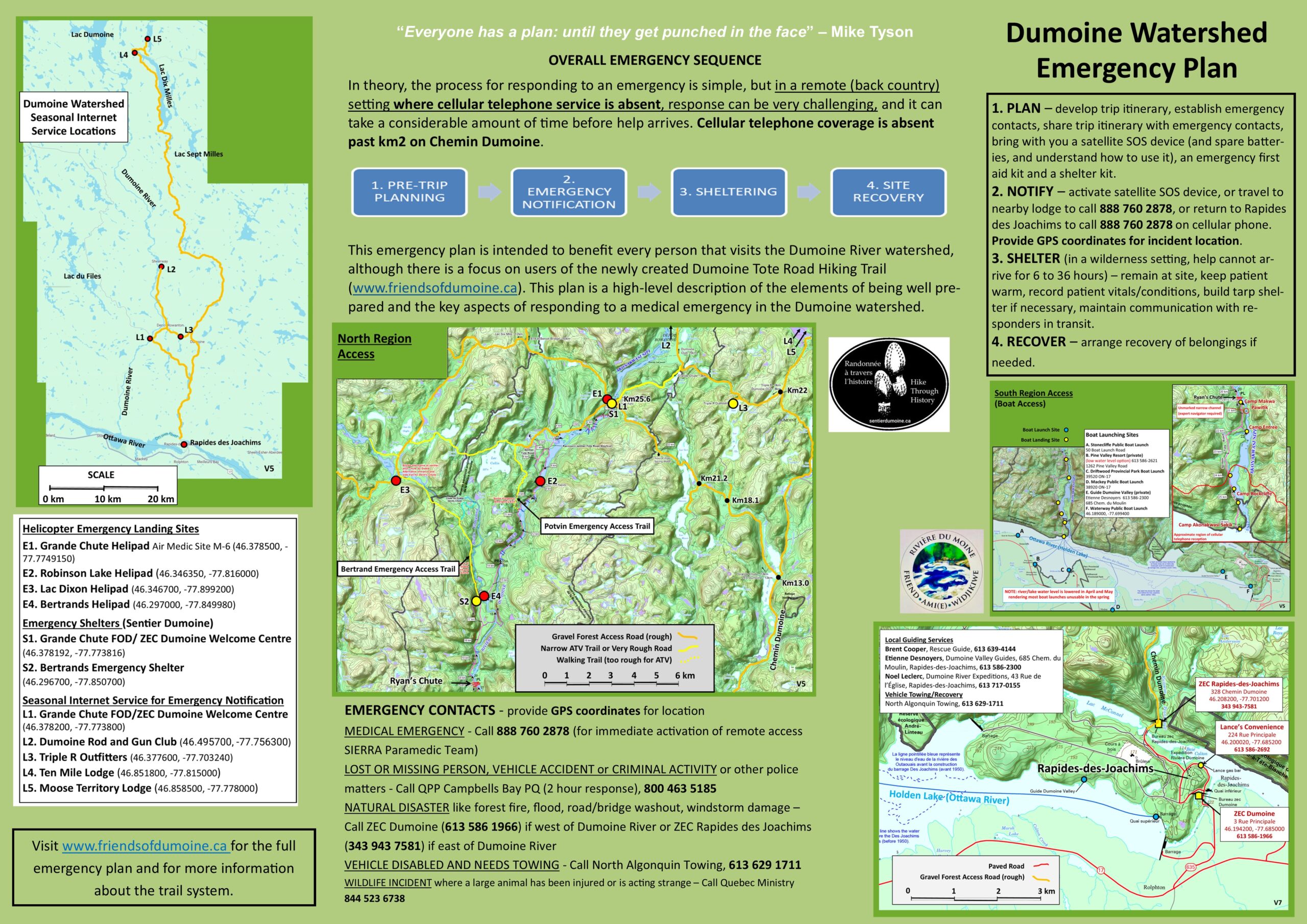
FOD has created an emergency planning document for the Dumoine Valley in recognition of the challenges of wilderness rescue. Reading this report is highly recommended. Hikers use Sentier Dumoine at their own risk and this guidance helps hikers to be aware of those risks and to manage them as effectively as possible.

The Dumoine Watershed Emergency Plan is a practical safety guide created by Friends of Dumoine to help visitors prepare for and respond to emergencies in the remote backcountry of the Dumoine River watershed. Because cellular service is largely unavailable beyond km 2 on Chemin Dumoine and rescue response times can range from 12–36 hours, preparation and communication planning are critical.
The plan focuses particularly on users of the Dumoine Tote Road Hiking Trail, but applies to all watershed visitors.
Cautionary Notes and Supporting Resources
Hiking Sentier Dumoine is a wonderful experience that is HIGHLY RECOMMENDED, but hiking in a wilderness area carries risks. The Dumoine Valley is a pristine wilderness area where THERE IS NO CELL PHONE COVERAGE. It is highly recommended that ALL HIKERS:
– Carry a satellite communication device (with extra batteries/power, and know how to use it)
– Know ahead of time who you would contact for help
– Exercise caution and conservatism in assessing the capabilities of your hiking group and in determining how far to hike
– Observe weather forecasts/conditions and adapt your plan accordingly
– Closely read the Dumoine Valley Emergency Plan
Conventional wilderness hazards include:
Slipping/tripping/falling, Animal encounters (moose, bear), Insect bites (particularly in June), Wasp/hornet stings (particularly in August), Other Resources and Information.